AC Capacitor Replacement Cost in Arizona (2026 Pricing Guide)
If your outdoor AC unit is humming but the fan won't spin, or the system trips the breaker the moment it tries to start, there's a very good chance the culprit is a $30 part called a capacitor. It's also, by a wide margin, the single most common AC failure we see in Arizona — the extreme heat literally cooks these things.
Here's what a capacitor replacement should actually cost in the Phoenix area in 2026, what drives the price up or down, and how to tell if the quote you're getting is fair.
What a capacitor does
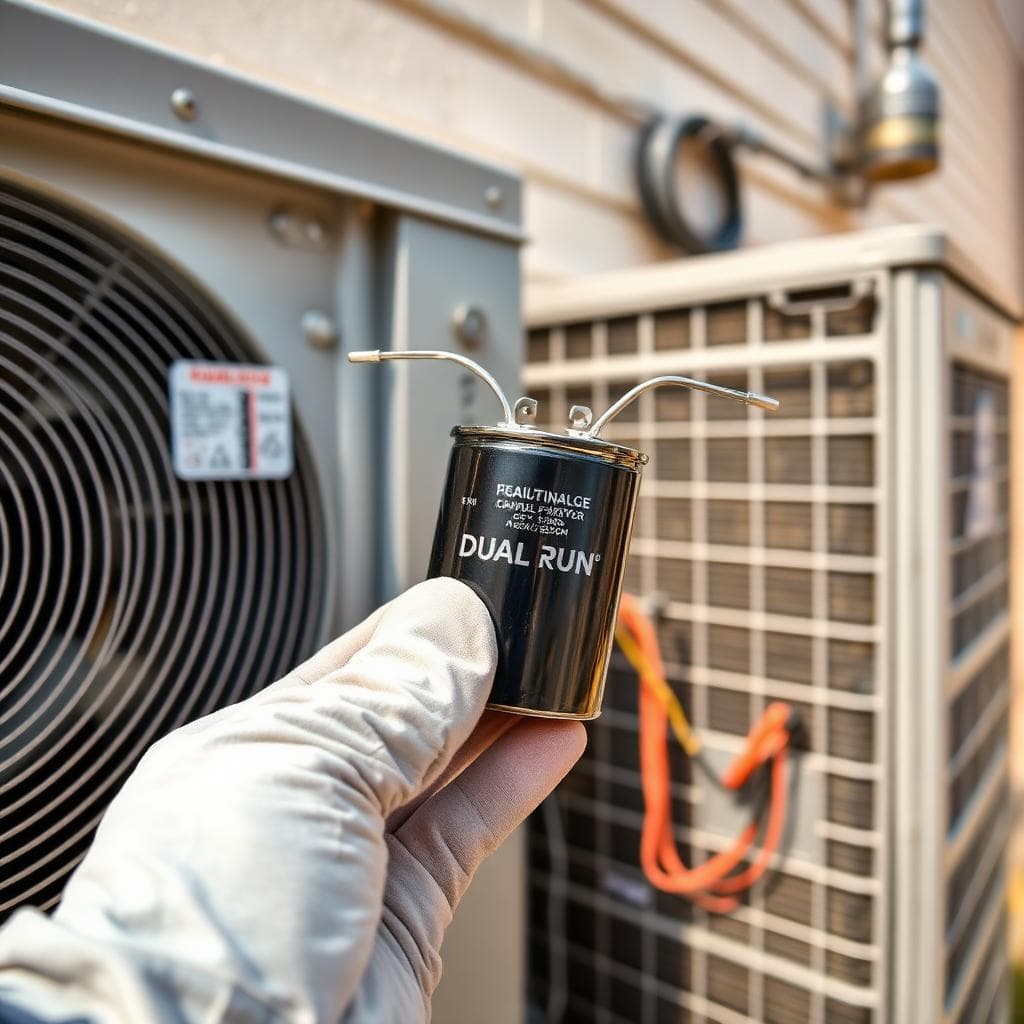
The capacitor is a small cylindrical component inside your outdoor condenser. Its job is to give the compressor and fan motor a jolt of extra electricity to get them spinning, and to keep them running steadily. When it fails, motors either won't start, start weakly, or overheat.
In Arizona, capacitors are working overtime. On a 115° day, the inside of that outdoor unit can hit 160°+, and heat is the #1 killer of capacitors. That's why we replace so many between May and September.
Typical replacement cost in Arizona
Most Arizona homeowners can expect to pay somewhere in this range for a straightforward capacitor replacement on a residential AC:
- Part only: $15–$60 depending on the model (a dual-run capacitor for a mid-size system usually runs $25–$45).
- Standard replacement (weekday, business hours): $180–$350 total, parts and labor included.
- After-hours or emergency call: $250–$500+ depending on time and travel.
- Weekend / holiday emergency: can hit $400–$600 at some companies.
At Fast Track, we keep pricing on this repair transparent because it's such a common one. If a shop is quoting you $700+ for a straight capacitor swap on a normal residential unit, get a second opinion.
What drives the price
Even for the same repair, quotes vary. Here's what's actually different when the numbers move:
- Time of day. Nights, weekends, and holidays cost more everywhere.
- Diagnostic / service call fee. Some companies fold this into the repair, others charge it separately (usually $75–$125).
- Capacitor type and size. Single-run capacitors are cheaper than dual-run. Higher microfarad ratings and higher-voltage units cost more.
- Brand-specific parts. Some system brands take proprietary capacitors that cost 2–3x a generic equivalent. A universal replacement is often fine — a good tech will discuss options.
- Warranty on the repair. A 1-year parts-and-labor warranty is standard. Anything shorter is a red flag.
Red flags in a capacitor quote
A capacitor is a replace, don't repair part — it's cheap, and every tech carries a range of sizes on the truck. Watch for these patterns:
- A quote over $500 with no other work being done
- A tech insisting you also need a new contactor, hard-start kit, or "tune-up package" without explaining why
- Being told the whole system needs replacing based on a capacitor failure alone — capacitors fail on healthy units all the time
- No printed or digital invoice showing the part number and warranty
How to make capacitors last longer
You can't stop Arizona heat, but you can slow the wear:
- Keep the outdoor unit shaded where possible, without blocking airflow.
- Clean the condenser coils at least once a year — a hot, dirty unit runs harder and cooks internal parts faster.
- Get an annual tune-up. A tech can measure your capacitor's microfarad rating and catch a weak one before it strands you on a 115° afternoon. We break down whether tune-ups are worth it in our AC tune-up guide.
When it's worth replacing vs. replacing the whole system
One failed capacitor on an otherwise healthy system? Just replace the capacitor. But if your system is 12+ years old and this is the third or fourth part failure in a couple of seasons, it may be time to think bigger. Our 5,000 rule guide walks through when repair stops making financial sense.
Why Capacitors Fail So Often in the Valley
Capacitors fail more often in Arizona than almost anywhere else in the country, and heat is the reason. A capacitor is an electrolytic component, and its lifespan is closely tied to operating temperature — the hotter it runs, the faster it degrades. The capacitor sits inside the outdoor unit, in direct sun, next to a compressor that is itself producing heat, on days when the air is already well above 110 degrees. It is close to a worst-case environment for this part.
That is why capacitors are the single most common no-cool call in the Valley during summer, and why they tend to fail in the hottest weeks rather than randomly through the year. A capacitor that has been drifting below its rated value for months will often fail outright on the first stretch of extreme heat, because that is when the component is hottest and the system is asking the most of it.
The useful consequence is that a capacitor is one of the few failures that can genuinely be predicted. A capacitor reading well below its rated value during a spring inspection is a capacitor that is likely to fail in summer. Replacing a weak one in March is a quick, inexpensive, scheduled job. The same part failing in July is an emergency call during the busiest period of the year.
- A bulging or domed top on the capacitor is a visible sign of failure, but many fail without showing it.
- A humming outdoor unit with a fan that does not spin is the classic capacitor symptom.
- A fan that starts spinning if nudged with a stick — which you should not do — is a strong indicator.
- Capacitors store a charge even with the power off. They are not a safe DIY replacement.
The Safety Case Against Doing This Yourself
Capacitor replacement is widely presented online as an easy DIY repair, and the parts are cheap and readily available. The reason we advise against it is not that the job is mechanically difficult. It is that a capacitor stores an electrical charge after the power is turned off, and that charge can be large enough to cause serious injury. Discharging one safely requires the right tool and the right technique, and that step is the one tutorials gloss over.
Beyond the shock risk, the common DIY failures are matching errors. A capacitor has to match the original in microfarad rating, voltage rating, and configuration, and dual-run capacitors serving both the compressor and fan have terminals that must be wired correctly. An incorrect value can damage the motor it serves, and an incorrectly wired dual capacitor can damage both. A capacitor that failed early may also be a symptom — of a failing motor drawing excess current, or of a condenser coil so dirty the whole unit is running hot — and replacing the part without finding that leaves the cause in place.
If your outdoor unit is humming without the fan turning, switch the system off at the thermostat and the breaker to protect the compressor, which is the expensive component at risk. Our guide to why an AC fan isn't spinning covers the overlap, and you can contact us for a same-day visit.
Get a fair quote
If your AC is humming, tripping breakers, or the outdoor fan won't spin, we can usually diagnose and replace a capacitor same-day. Fast Track Heating & Cooling serves Mesa, Chandler, Gilbert, and the East Valley — see our Mesa AC repair page or Chandler AC repair page for area specifics, or schedule a service call. You can also reach us directly at (602) 905-4528.
Related Services
Need HVAC Help in Arizona?
Fast Track Heating & Cooling offers free estimates on all HVAC services across the Valley.
Call (602) 905-4528