Why Your Heat Pump Blows Cool Air in an Arizona Winter
Every December we take calls from Valley homeowners convinced their heat pump is broken. The house is heating. The thermostat is satisfied. But when they hold a hand up to a register, the air feels cool — and that does not match what heat is supposed to feel like.
In most of those cases nothing is wrong at all. Heat pumps simply produce heat in a way that feels different from a furnace, and if you have moved to Arizona from somewhere with gas heat, the sensation is genuinely disconcerting the first time.
This article explains why that happens, what else is normal, and where the line sits between normal and a real fault. If your heat pump is producing no heat whatsoever, this guide is the more useful one.
The Short Version: 95 Degrees Feels Cool
Your skin sits at roughly 90 to 95 degrees. Anything close to that temperature registers as neutral or slightly cool, not warm.
A gas furnace delivers air at roughly 120 to 140 degrees. Hold your hand to a register and it is unmistakably hot — well above skin temperature, so your nerves read it as heat.
A heat pump delivers air at roughly 90 to 100 degrees. That is warmer than your house, so it heats the room perfectly well over time. But it is right at skin temperature, so your hand reports "not hot" and your brain concludes "not working."
Both systems get the room to 70 degrees. They just do it differently — the furnace in short, intense bursts, the heat pump as a long, gentle, continuous supply. Neither is defective.
Long Run Times Are Normal Too
The second thing that worries people is how long a heat pump runs. A furnace might run twelve minutes and shut off. A heat pump can run for an hour or more on a cold morning, sometimes almost continuously.
That is by design and it is where the efficiency comes from. A heat pump does not burn fuel to create heat; it moves existing heat from outdoor air into your house. Moving heat takes less energy than making it, which is why heat pumps are cheap to run — but it works best as a slow, steady transfer rather than a burst.
A heat pump that runs long and steady while holding your setpoint is operating exactly as intended. A heat pump that runs constantly and never reaches setpoint is a different story, and that one is worth investigating.
Defrost Mode: The Cool Air Has a Reason
Here is the behavior that most often gets reported as a fault.
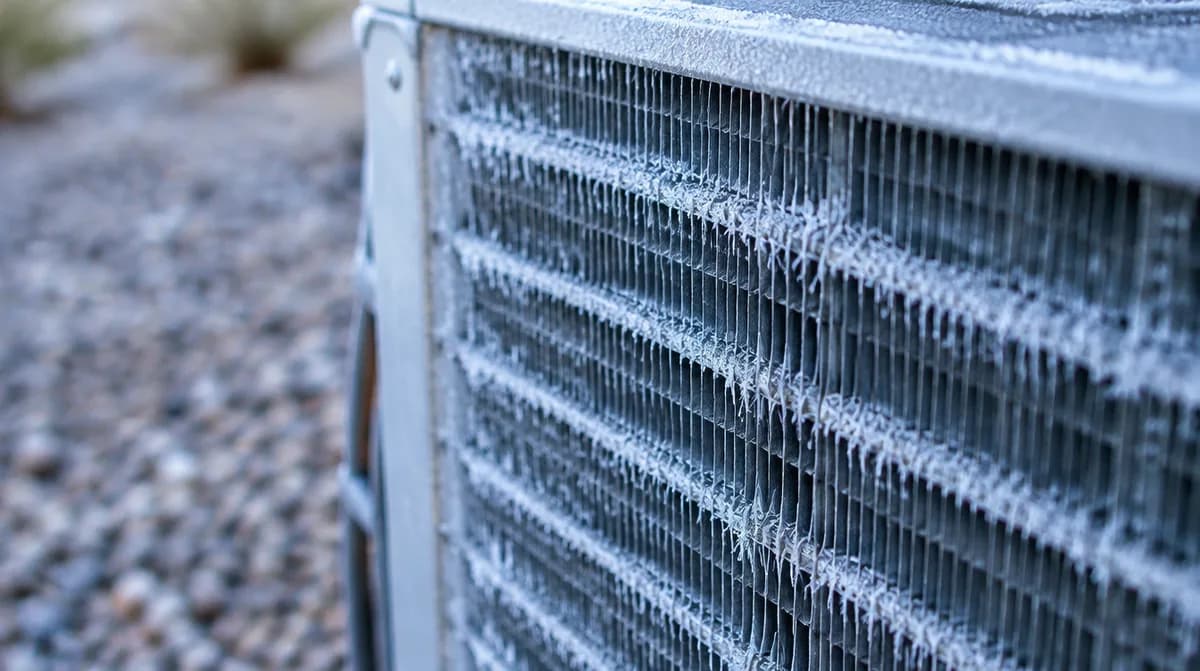
In heating mode, the outdoor coil gets colder than the outside air — that is how it absorbs heat. When outdoor conditions are cool and there is any moisture around, frost can form on that coil. Frost insulates it, and an insulated coil cannot absorb heat, so the system has to clear it.
To do that, the heat pump briefly reverses itself. For a few minutes it runs in cooling mode to send hot refrigerant out to the outdoor coil and melt the frost off. During those minutes the indoor coil is doing the opposite of heating.
What you observe from inside:
- The outdoor fan stops while the compressor keeps running.
- You may hear a loud whoosh or clunk as the reversing valve shifts.
- Steam rises off the outdoor unit — often mistaken for smoke, and completely harmless.
- Indoor air turns cool for a few minutes.
- Your thermostat may display "defrost" or temporarily show auxiliary heat.
- After five to fifteen minutes everything returns to normal heating.
In Arizona this happens far less than in humid climates — there is simply less moisture available to freeze — but it does happen on cool, damp mornings, particularly after a winter rain. A defrost cycle every so often on a cold morning is a healthy system protecting itself.
Defrost becomes a problem when it runs constantly, when ice persists on the coil through multiple cycles, or when the unit never returns to heating afterwards. Those point at a stuck reversing valve, a failed defrost control or sensor, or low refrigerant.
Auxiliary Heat and Emergency Heat Are Not the Same Thing
Most Arizona heat pumps include electric resistance heat strips in the air handler as backup. Your thermostat deals with them in two distinct ways, and confusing the two costs real money.
Auxiliary heat comes on automatically when the heat pump alone cannot keep up — typically on the coldest mornings, or when you have asked for a large temperature jump at once. The thermostat runs the strips alongside the heat pump, you get warmer air, and the indicator turns off once the system catches up. This is normal and occasional.
Emergency heat is a mode you select manually. It shuts the heat pump off entirely and heats with the resistance strips alone. It exists for when the heat pump has genuinely failed and you need warmth tonight. It is substantially more expensive to run, because resistance heat creates heat rather than moving it.
The mistake we see constantly: someone switches to Emergency Heat in December because the air felt cool, the house warms up nicely, and the setting never gets changed back. The January bill is a shock. If your thermostat is on EM HEAT and your heat pump is not actually broken, switch it back to HEAT.
Seeing "AUX" come on briefly during a cold snap is fine. Seeing it on all day, every day, in mild weather is a signal that the heat pump is not carrying its share.
When Cool Air Is Actually a Problem
Having covered what is normal, here is what is not. Any of these are worth a diagnosis:
- The air is genuinely cold, not just mild. Cooler than room temperature means the system is running in cooling mode — usually a reversing valve stuck in the cooling position, or a thermostat not configured for heat pump operation.
- The house never reaches setpoint, even running continuously for hours.
- Auxiliary heat runs constantly in mild weather rather than occasionally on cold mornings.
- Ice builds on the outdoor unit and never clears across multiple defrost cycles.
- Heating performance has clearly declined from previous winters.
- The outdoor unit is not running at all when the thermostat calls for heat.
- The electricity bill has spiked with no change in how you use the house.
That last one deserves emphasis because it is the signal people most often miss. A failing heat pump does not necessarily leave you cold — the backup strips quietly pick up the slack and keep the house comfortable. The failure shows up as a bill rather than as discomfort, which is why it often runs for an entire winter before anyone investigates.
Getting More Comfort Out of a Working Heat Pump
If your heat pump is healthy but the mild air still bothers you, a few things genuinely help.
Stop using deep setbacks. Dropping the thermostat ten degrees overnight and asking for it back at 6am forces the system into auxiliary heat to recover quickly, which is both expensive and the opposite of how a heat pump wants to work. A smaller setback, or none at all, usually costs less and feels better. Our guide on thermostat settings covers the same principle for cooling.
Set the fan to AUTO rather than ON. Continuous fan operation moves room-temperature air between heating cycles, which feels like a draft and is a common reason people describe a working system as blowing cold.
Keep the filter clean. Restricted airflow reduces delivered air temperature and pushes the system toward backup heat.
Check for drafts and insulation gaps. Heat pumps deliver gentle heat, so a house that loses heat quickly shows it more than it would with a furnace blasting 140-degree air.
And keep the outdoor unit clear. It is collecting heat from the air, and it needs room to breathe — plants, dust, and stacked items all reduce capacity.
Frequently Asked Questions
How warm should heat pump air actually be? Roughly 90 to 100 degrees at the register, or about 20 to 30 degrees warmer than the air going into the return. It should feel mild rather than hot.
Why does my heat pump steam in the morning? That is a defrost cycle melting frost off the outdoor coil. It is water vapour, not smoke, and it is normal.
Is it cheaper to leave the heat pump on all day or turn it off? Generally cheaper to hold a steady temperature. Large recoveries trigger auxiliary heat, which costs considerably more than the heat pump running gently.
Should I switch to Emergency Heat when it is cold? No — not unless the heat pump has actually failed. Auxiliary heat engages on its own when needed. Emergency heat turns the efficient part of your system off.
Do heat pumps even make sense in Arizona? They make more sense here than almost anywhere. Mild winters are exactly the conditions heat pumps are most efficient in, and you get one piece of equipment doing both jobs. Heat pump versus air conditioner covers the comparison.
Still Not Sure If It's Normal?
If the air is genuinely cold rather than mild, the house will not reach setpoint, or auxiliary heat is running constantly, it is worth having the system measured rather than guessed at.
Fast Track Heating & Cooling services heat pumps across Mesa, Chandler, Gilbert, Tempe, Scottsdale, and the East Valley. See our heat pump repair service, heat pump repair in Chandler, or our HVAC preventative maintenance. Book online or call (602) 905-4528.
Related Services
Need HVAC Help in Arizona?
Fast Track Heating & Cooling offers free estimates on all HVAC services across the Valley.
Call (602) 905-4528