Heat Pump Not Heating? An Arizona Troubleshooting Guide
If your home was built in the Phoenix metro in the last few decades, there is a good chance you do not have a furnace at all. You have a heat pump — the same outdoor unit that cools the house in July, running in reverse to heat it in December.
That matters enormously for troubleshooting, because a heat pump fails in ways a furnace never does, and several of its normal behaviors look like failures to someone expecting furnace-style heat.
This guide covers a heat pump that is genuinely not heating. If yours is running and producing air that is warm but underwhelming, that is a different and much more common situation — see why a heat pump blows cool air in an Arizona winter first, because you may not have a problem at all.
How to Confirm You Have a Heat Pump
Three quick checks:
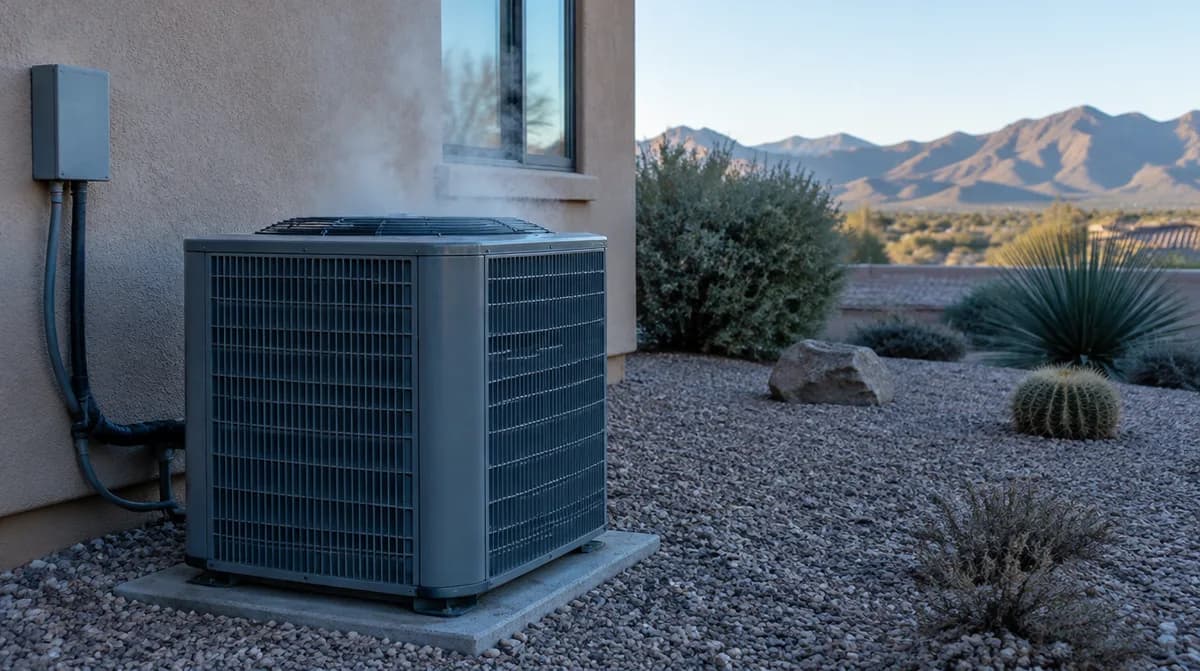
- On a cold morning with the heat running, go outside. If the outdoor unit is running, you have a heat pump. A gas furnace leaves the outdoor unit completely idle in winter.
- Look at your thermostat. An "Emergency Heat" or "Em Heat" setting means a heat pump. Furnaces do not have one.
- Look for a gas line and a flue. A heat pump has neither — no gas pipe to the indoor cabinet, no exhaust venting out the roof.
If you have a gas furnace instead, our furnace not turning on guide is the right one. If you are not sure what the difference means for your home more broadly, heat pump versus air conditioner in Arizona covers it.
Start With the Thermostat
More no-heat heat pump calls come down to the thermostat than to the equipment.
Set the mode to HEAT, not AUTO and not EM HEAT. AUTO can sit idle in mild weather. Emergency heat bypasses the heat pump entirely and runs expensive backup heat instead — useful in a genuine failure, punishing on a utility bill if left on by accident.
Push the setpoint at least five degrees above the current room temperature so the system has a clear reason to run.
Replace the batteries. Weak batteries produce intermittent faults long before the display goes blank, and heat pumps are particularly sensitive because the thermostat has to switch a reversing valve as well as call for heat.
One heat-pump-specific point: if your thermostat was replaced at some point, it needs to be configured for a heat pump. A thermostat set up as a conventional furnace will not control the reversing valve correctly, and the symptom is often cooling when you ask for heating, or no heating at all. This is a common leftover from a DIY smart thermostat installation.
Check Power at Both Units
A heat pump has two halves and they have separate power supplies. Both need to be on.
Check your breaker panel for both the air handler circuit and the outdoor unit circuit — the outdoor one is usually a larger double breaker. Reset anything tripped, firmly off then on. If a breaker trips again immediately, stop and call someone; that is a fault rather than a nuisance.
There is also a disconnect box mounted on the wall beside the outdoor unit. It contains a pull-out block or a switch, and it gets left off after service work more often than you would expect.
Indoors, find the air handler service switch. It looks like an ordinary light switch and is usually on or near the cabinet, often in a closet, garage, or attic. Attic installations frequently have a second switch at the top of the access ladder.
Check the Filter and the Outdoor Coil
Airflow matters as much for heating as for cooling. A clogged filter restricts the air moving across the indoor coil, and the system cannot deliver heat it cannot move. Arizona dust loads filters quickly — if you cannot see light through yours, replace it.
Then go look at the outdoor unit. In heating mode this coil is absorbing heat from outdoor air, and it needs clear airflow to do it. Check for leaves, dust buildup, overgrown oleander or bougainvillea crowding the cabinet, and anything stacked against it. Two feet of clearance on all sides is a reasonable target.
A heat pump pulling heat from the air through a coil packed with dust is working hard for very little return, and in marginal conditions it will fall back on expensive backup heat rather than heating properly.
The Reversing Valve: The Part That Makes It a Heat Pump
A heat pump is an air conditioner with one extra component: a reversing valve that flips the direction refrigerant flows, so the outdoor coil absorbs heat instead of rejecting it.
When that valve fails or sticks, the results are distinctive. The most recognizable symptom is a system that blows cold air when set to heat — it is still running in cooling mode because the valve never switched. Another is a heat pump that cools perfectly in summer and does nothing useful in winter, which makes sense once you know that cooling is the valve's default position.
You may also hear a distinct whoosh or clunk as the valve shifts, which is normal. What is not normal is a system that cools fine and heats not at all.
This is not a DIY repair — it involves the sealed refrigerant circuit. But recognizing the symptom saves diagnostic time, and in Arizona it is a fairly common failure precisely because the valve spends eight or nine months of the year in one position and only gets asked to move when the weather turns.
Refrigerant: Low Charge Hurts Heating More Than Cooling
A heat pump moves heat rather than creating it, and refrigerant is what does the moving. If the charge is low, capacity drops — and it drops further in heating than in cooling, because there is less heat available outdoors to collect in the first place.
A system that cooled acceptably all summer can be noticeably inadequate at heating with the same slow leak. Homeowners often read this as "the heat pump is weak" rather than as a refrigerant problem.
Signs include heat that gets worse as outdoor temperatures drop, ice on the outdoor unit that does not clear, a system running constantly without reaching setpoint, and backup heat engaging far more than it should. Our guide on signs your system needs refrigerant covers the diagnostics.
Worth saying plainly: refrigerant is not consumed. A system low on charge has a leak, and simply adding more without finding it is a temporary and expensive cycle.
Backup Heat and Why Your Bill Spiked
Most Arizona heat pumps have electric resistance heat strips as backup — essentially a large electric heater in the air handler. They exist for the handful of mornings when the heat pump alone cannot keep up, and they are considerably more expensive to run than the heat pump itself.
If your heat pump is failing, the system will often lean on those strips to maintain temperature. The house may stay roughly comfortable, which is exactly why the failure goes unnoticed — until the electricity bill arrives.
A December or January bill that is dramatically higher than the same month last year, with no change in habits, is a genuine diagnostic signal. It often means the heat pump is not carrying its share and backup heat is doing the work.
The reverse problem exists too: if the heat strips themselves have failed, you lose your safety margin on the coldest mornings and the house simply will not reach setpoint.
What You Can Check in Fifteen Minutes
Before calling, work through these:
- Thermostat set to HEAT — not AUTO, not EM HEAT — with the setpoint well above room temperature.
- Fresh thermostat batteries.
- Both breakers on, and the outdoor disconnect pulled block seated.
- Air handler service switch on.
- Clean filter.
- Outdoor unit clear of plants, dust, and debris, with clear space around it.
- Note whether the outdoor unit is actually running when you call for heat. That single observation narrows the diagnosis significantly.
- Note whether the air at the register is cold, mild, or hot — and whether the system cooled normally last summer.
Frequently Asked Questions
Should I just use Emergency Heat? As a short-term measure on a cold night, yes — it will keep the house warm. As an ongoing setting it is expensive, because it runs resistance heat instead of the heat pump. Treat it as a stopgap until the system is repaired.
My heat pump cooled fine all summer. Why can't it heat? The most likely answers are a reversing valve that is not switching, a thermostat not configured for heat pump operation, or a refrigerant charge low enough to matter in heating but not in cooling.
Is ice on the outdoor unit normal in winter? A light frost that clears during a defrost cycle is normal. Thick ice that persists is not and should be looked at.
Why does my heat pump run so much longer than a furnace would? Because it delivers milder air over a longer period rather than blasting hot air briefly. Long run times are normal and efficient for a heat pump.
How long should a heat pump last in Arizona? Typically 12 to 15 years, and often shorter than in mild climates because it runs hard for a long cooling season. Our repair versus replace guide covers how to judge whether an ageing system is worth keeping.
Get Your Heat Pump Diagnosed
If the thermostat is set correctly, both breakers are on, and the filter is clean but your heat pump still is not heating, the remaining causes are in the refrigerant circuit or the controls — and both need instruments to diagnose properly.
Fast Track Heating & Cooling services heat pumps across Mesa, Chandler, Gilbert, Tempe, Scottsdale, and the East Valley. See our heat pump repair service, heat pump repair in Mesa, or HVAC service across the East Valley. Book online or call (602) 905-4528.
Related Services
Need HVAC Help in Arizona?
Fast Track Heating & Cooling offers free estimates on all HVAC services across the Valley.
Call (602) 905-4528