Why Is My Furnace Leaking Water? An Arizona Homeowner's Guide
Finding a puddle under your furnace is unsettling, mostly because it seems like it should not be possible. Furnaces burn gas and make heat. Where is water even coming from?
The answer depends almost entirely on what kind of furnace you have, and the difference matters: on some systems a small amount of water is completely expected and the problem is only that it is not draining. On others, water should never appear at all and its presence points at something that needs attention quickly.
In Arizona there is a third possibility that catches people out, which is that the water has nothing to do with heating at all.
Step One: Shut It Down
Before diagnosing anything, turn the system off at the thermostat and at the furnace service switch — the light-switch-looking one on or near the cabinet. If water is pooling near electrical components, running the system risks a short, and a short near a gas appliance is not a risk worth taking to save an hour of discomfort.
Mop up standing water and put down towels. Then work out where it is coming from before you turn anything back on.
High-Efficiency Furnaces Make Water on Purpose
If your furnace vents through white PVC pipe rather than metal, you have a high-efficiency condensing furnace — 90% AFUE or better. These are designed to extract so much heat from the exhaust that the water vapor in it condenses back into liquid. A condensing furnace can produce several gallons of water a day during heavy use.
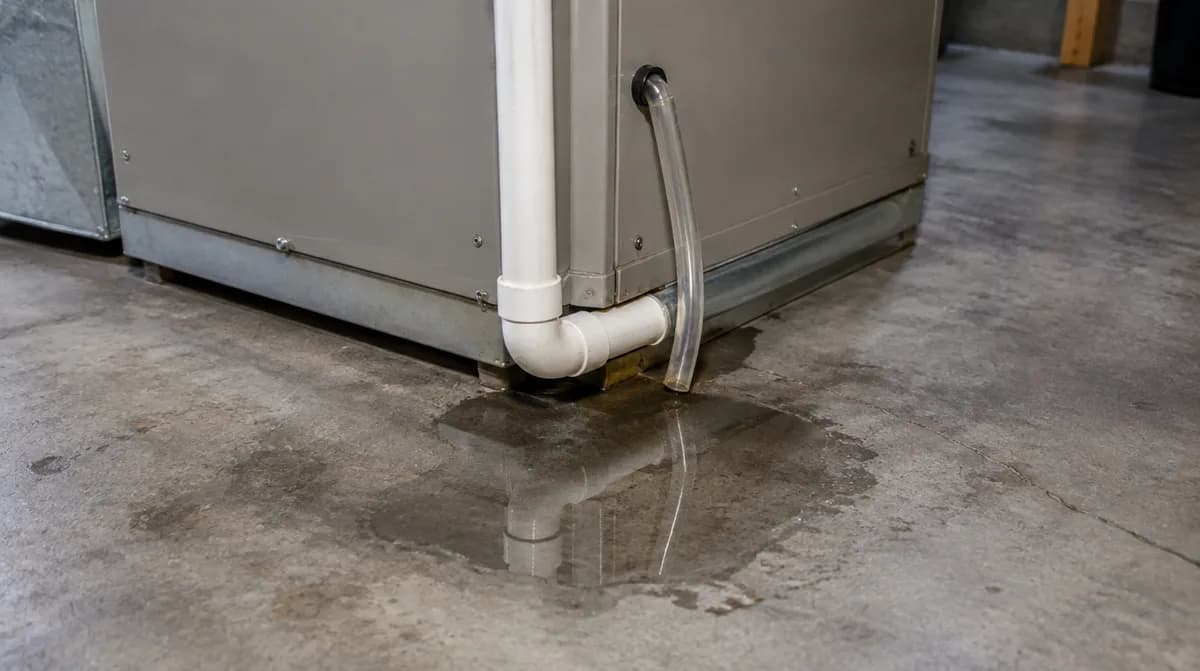
That water is mildly acidic, and the furnace has a dedicated drain system to get rid of it: a collector box, a condensate trap, tubing, and often a small condensate pump if the furnace sits below the drain line. Any blockage anywhere in that chain and the water has to go somewhere else.
This is the most common reason a furnace leaks, and in Arizona it has a specific seasonal cause. Your heating system sits unused from roughly March to November. Condensate traps dry out completely over those eight months, and the residue left behind hardens. Dust gets in. When the furnace fires up for the first time in November and starts producing water again, it meets a blockage that was not there in February.
The good news is that this is usually a straightforward clear-out rather than a component failure.
- A clogged condensate trap or drain line, often from dried residue and dust.
- A cracked or disconnected drain hose — the plastic gets brittle over years of thermal cycling.
- A failed condensate pump, which will sit there full while water backs up.
- A drain line that was never properly sloped, so water sits rather than running out.
- A clogged or corroded collector box inside the furnace itself.
Standard-Efficiency Furnaces Should Never Leak
If your furnace vents through a metal flue pipe, it is a conventional 80% AFUE unit. It does not condense, and it has no drain system because it is not supposed to produce water. Water around one of these means something is genuinely wrong.
The most likely cause is a flue problem. If the exhaust cannot escape properly — because the vent is blocked, improperly sized, or disconnected — combustion gases cool inside the pipe and condense. That water runs back down into the furnace. A bird's nest or a rodent nest in a flue after a long idle summer is a very real Arizona scenario, and a blocked flue is a carbon monoxide concern as much as a water one.
The other possibility is a cracked heat exchanger. This is less common as a cause of visible water, but it is serious enough to rule out. Have it checked rather than assumed.
It Might Not Be the Furnace at All
In most Arizona homes the furnace or air handler shares a cabinet and a drain with the air conditioning evaporator coil. That coil pulls real moisture out of the air every summer day, and it drains through the same condensate system.
So before concluding your heating system is at fault, consider whether the water is actually from cooling. If you are running the AC in October — and plenty of Valley homeowners are — a clogged AC condensate drain produces exactly the same puddle in exactly the same place. Our guide on a clogged AC drain line covers that scenario in full, and why an AC leaks water covers the broader version.
A whole-house humidifier, if you have one, is another candidate — they are uncommon here given the climate, but not unheard of in homes where someone installed one for comfort.
Finally, rule out plumbing. A water heater, a water softener, or a supply line in the same closet can leak and leave water that appears to come from the furnace simply because the furnace is the biggest thing in the room. Check whether the water is warm, whether it smells of anything, and whether it stops when the furnace is off.
What You Can Safely Check Yourself
With the system off:
- Trace the drain line from the furnace and find the outlet. Look for standing water at the trap or visible gunk in clear tubing.
- Check that the drain hose is actually attached at both ends and has not slipped off a fitting.
- If there is a condensate pump, look at the reservoir. Full and not pumping means a failed pump or a float switch stuck in place.
- Replace the air filter. A frozen evaporator coil caused by restricted airflow melts into exactly this kind of puddle.
- Look at the flue pipe where it leaves the furnace. Any obvious disconnection, corrosion, or sag is worth reporting.
- Check whether the water is clean or rusty. Rusty water has been sitting against metal for a while, which suggests this has been happening longer than you noticed.
Why This Is Worth Fixing Quickly
It is tempting to put a bucket under it and deal with it after the holidays. Three reasons not to.
Condensate from a high-efficiency furnace is acidic. Left to sit, it corrodes the furnace base, the surrounding metal, and whatever it is dripping onto. We have replaced furnaces whose cabinets rusted through from the inside because a drain was clogged for two seasons.
Water and electricity share a cabinet here. Control boards and blower motors are not cheap, and a water-damaged board is a much larger repair than a cleared drain.
And in a dry climate, sustained moisture against drywall and framing is one of the few ways to get mould in an Arizona house. Our humidity normally protects us from that. A slow leak removes the protection.
If the furnace is in an attic — common in Mesa and Gilbert homes — the stakes are higher still, because the first sign of a problem is often a stain on a bedroom ceiling.
When to Call Someone
Call rather than continue if any of the following apply: the furnace vents through metal and is leaking anyway, you find rust or soot inside the cabinet, the water keeps returning after you clear the drain, the unit is in an attic over finished space, or a carbon monoxide alarm has gone off at any point.
Also call if you simply cannot find the source. Guessing wrong on this one is expensive, and the diagnostic is quick for someone who does it regularly.
Frequently Asked Questions
Is a leaking furnace dangerous? The water itself is mostly a damage problem rather than a safety one. But two of the possible causes — a blocked flue and a cracked heat exchanger — are carbon monoxide concerns, which is why a conventional furnace leaking water should be inspected rather than ignored.
Can I run the furnace while it is leaking? Not advisable. You risk electrical damage and you are allowing continued water damage while the root cause stays unaddressed.
How much water is normal? For a high-efficiency furnace, a steady trickle through the drain line is normal. Anything on the floor is not.
Why did this start as soon as I turned the heat on for the first time? Almost certainly a condensate trap or drain line that dried out and clogged over an eight-month Arizona summer. It is one of the most predictable November failures there is.
Could it be my air conditioner instead? Easily, especially in early autumn when you may still be cooling. Same cabinet, same drain, same puddle.
Get the Leak Sorted
Water around heating equipment is one of those problems that is usually cheap to fix now and expensive to fix later.
Fast Track Heating & Cooling handles furnace leaks and condensate problems across Mesa, Chandler, Gilbert, Tempe, and the East Valley. See our furnace repair service, furnace repair in Gilbert, or our furnace maintenance inspection — which is where a clogged condensate line normally gets caught before it becomes a puddle. Book online or call (602) 905-4528.
Related Services
Need HVAC Help in Arizona?
Fast Track Heating & Cooling offers free estimates on all HVAC services across the Valley.
Call (602) 905-4528