How Much Does an AC Tune-Up Cost in Mesa? (2026 Pricing)
An AC tune-up is the cheapest thing you can buy from an HVAC company — and in Mesa, it's also the single service with the biggest impact on whether your system survives August. But "tune-up" is one of the least standardized words in this industry. One company's $29 tune-up is a filter change and a sales pitch. Another company's $149 tune-up is 60–90 minutes of real testing with numbers written down.
This guide breaks down what an AC tune-up actually costs in Mesa and the East Valley in 2026, what should be included at each price point, and how to tell the difference between a real inspection and a lead-generation visit.
AC tune-up cost in Mesa: 2026 price ranges
Here's what homeowners in Mesa, Gilbert, Chandler, and the surrounding East Valley are typically paying this year. These are ranges across the local market, not a quote:
- Single-system standard tune-up: $89–$179 for a full inspection with refrigerant pressure readings, electrical testing, and coil evaluation.
- Promotional / first-visit tune-up: $49–$99, usually offered in spring to earn a new customer. Legitimate when the checklist is published — see the red flags below.
- Second system (same visit): $59–$120. Almost every company discounts the second unit because the truck is already there.
- Heat pump tune-up: $110–$200. More components to test because the system reverses for heating.
- Maintenance plan (annual): $150–$300 per year, typically covering two visits (spring cooling, fall heating) plus priority scheduling and a repair discount.
- Add-on: condenser coil deep clean: $75–$200 depending on how caked the coil is with desert dust.
- Add-on: drain line clear and treat: $75–$150 if the line is already clogged rather than just flushed.
The spread mostly comes down to time on site. A $49 visit buys 20 minutes. A $149 visit buys an hour or more with a technician who is measuring things, not just looking at them.
What a real AC tune-up includes
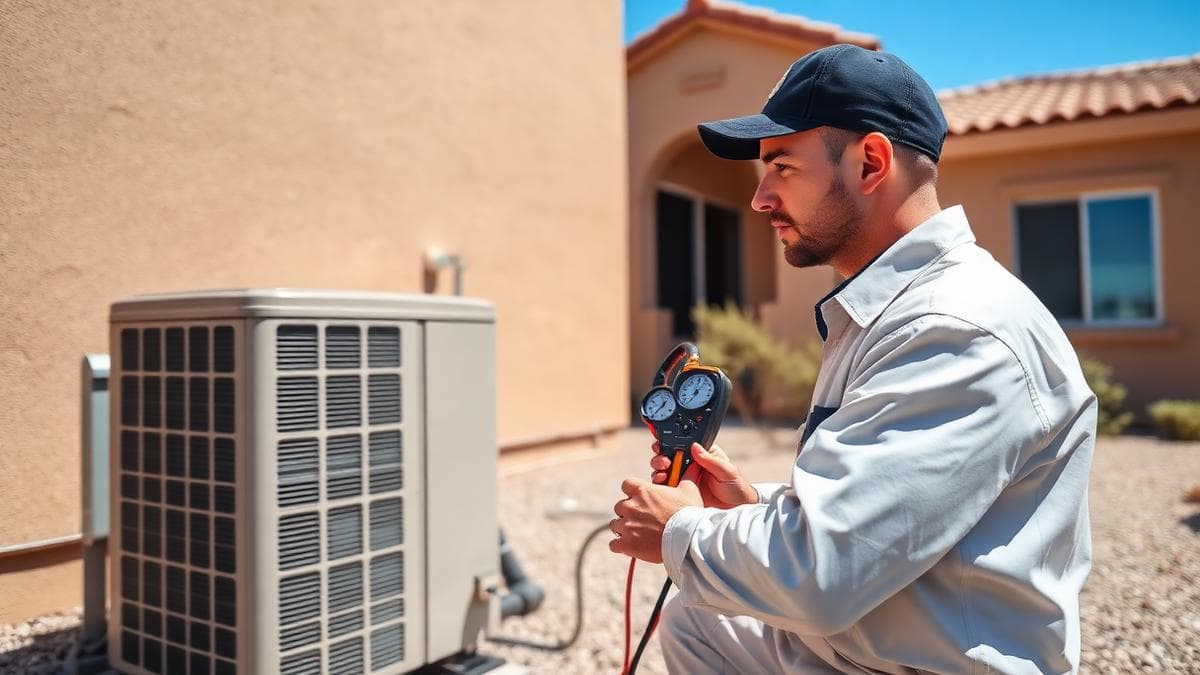
If you're paying for a tune-up, you should be getting measurements you can read on the invoice — not a checkbox that says "system operating normally." A complete Arizona tune-up covers:
- Refrigerant pressures and superheat/subcooling — the only reliable way to tell if the charge is correct.
- Temperature split — supply air vs. return air. In a healthy system you want roughly a 16–22° drop.
- Capacitor microfarad reading — a capacitor rated at 45 μF that's testing at 38 μF is going to fail, probably during a heat wave.
- Contactor inspection — pitted or burned contacts are one of the most common no-cool causes we find.
- Amp draw on the compressor and fan motors — rising amp draw is an early warning of a failing motor.
- Condenser coil condition and cleaning — Mesa dust and monsoon debris insulate the coil and force the compressor to work against higher head pressure.
- Evaporator coil and blower inspection — dust on the indoor coil quietly kills airflow.
- Condensate drain flush — a clogged line floods the pan and can trigger a safety switch shutdown.
- Electrical connections tightened — heat cycling loosens terminals every single summer.
- Thermostat calibration and cycle test — confirming the system actually responds the way it's told to.
Our full seasonal breakdown of what to check and when lives in the Arizona HVAC maintenance checklist.
Why Mesa systems need tune-ups more than most of the country
A national article will tell you a tune-up is a nice-to-have. In the East Valley, the math is different, and it's driven by three local realities:
- Run hours. A Mesa AC can run 3,000+ hours a year. A system in Ohio might run 700. Your equipment ages roughly four times faster in terms of wear.
- Heat load on components. On a 115° afternoon, the inside of an outdoor condenser can exceed 160°. Capacitors, contactors, and control boards degrade fast at those temperatures.
- Dust and monsoon debris. Desert dust plus haboob season packs condenser fins and coats indoor coils. A dirty coil can raise energy use noticeably and drop cooling capacity right when you need it most.
That's why the timing matters as much as the service. The best window in Mesa is February through April — before the first 100° day, while technicians still have open schedule. Booking a tune-up in July means competing with every no-cool emergency in the Valley.
Red flags: what the $29 tune-up usually is
Deep-discount tune-ups aren't automatically a scam — but they're a marketing expense for the company, and the visit has to earn that money back somehow. Watch for:
- No published checklist. If a company won't tell you what the tune-up includes before you book, that's the answer.
- No numbers on the invoice. Pressures, temperature split, capacitor reading, amp draws. If none of that is written down, nothing was measured.
- A replacement quote on the first visit with no failed component. A tune-up on a 9-year-old system that ends in a $14,000 proposal and no test data is a sales call.
- Scare language without evidence. "Your compressor could go any day" should be backed by an amp reading or a pressure number.
- Fees added on arrival. A $29 tune-up that becomes $189 once the tech is at the unit isn't a $29 tune-up.
Does a tune-up actually save money?
Two ways, and they're very different in size.
Efficiency. A clean coil, correct charge, and good airflow keep the system operating near its rated efficiency. On a Mesa summer bill, that difference is real but modest — think a slice off a monthly bill rather than a dramatic drop.
Avoided failure. This is where the money is. A weak capacitor caught in March is a routine $200-ish repair on a normal weekday. That same capacitor failing at 6 p.m. on a 116° Saturday becomes an emergency call — and if the compressor was running hard against the fault before you shut it down, the bill can climb into four figures. We break the capacitor side down in detail in our AC capacitor replacement cost guide.
The honest summary: a tune-up is not primarily an energy-savings product in Arizona. It's failure insurance with an efficiency bonus.
Tune-up, repair, or replace?
A tune-up is the right call when the system is cooling and you want it to keep cooling. It's the wrong call if the system is already failing — pay for a diagnostic instead so the technician is hunting a specific fault.
If your system is 12+ years old and the tune-up turns up multiple aging components, the conversation shifts to replacement math. The common shorthand is the $5,000 rule: multiply the age of the system by the repair cost, and if the result clears $5,000, replacement usually makes more financial sense. We work that out with real numbers in What does a new AC unit cost in Arizona.
Frequently asked questions
How much does an AC tune-up cost in Mesa, AZ? Most Mesa homeowners pay $89–$179 for a full single-system tune-up in 2026, with promotional pricing as low as $49–$99 and heat pumps running $110–$200.
How often should I get an AC tune-up in Arizona? Once a year minimum, ideally in late winter or early spring. Homes with two systems, heavy dust exposure, pets, or equipment over 10 years old benefit from twice-yearly service.
Is an AC tune-up worth it? In Arizona, yes — mainly for failure prevention rather than energy savings. We go deeper on that in Is an AC tune-up worth it in Arizona.
What is the $5,000 rule? Multiply your system's age in years by the cost of the proposed repair. If the number exceeds $5,000, replacing usually beats repairing.
How long does a tune-up take? A thorough one takes 45–90 minutes for a single system. Anything under 20 minutes was a visual inspection, not a tune-up.
Can I do it myself? You can change filters, rinse the condenser gently with a hose (power off), keep 2 feet of clearance around the unit, and pour a cup of distilled vinegar down the drain line. Refrigerant, electrical, and capacitor work require a licensed technician.
Book a tune-up in Mesa
Fast Track Heating & Cooling performs full-checklist AC tune-ups across Mesa, Gilbert, Chandler, Tempe, and the East Valley — with the readings written on your invoice so you can see what we found. See our HVAC preventative maintenance service, our AC maintenance in Chandler or AC tune-up in Mesa pages, or schedule online. You can also call us at (602) 905-4528.
Related Services
Need HVAC Help in Arizona?
Fast Track Heating & Cooling offers free estimates on all HVAC services across the Valley.
Call (602) 905-4528