Furnace Short Cycling: Why It Turns On and Off Every Few Minutes
Short cycling is when your furnace starts, runs for a few minutes, shuts off, and then starts again a short while later — over and over, without ever satisfying the thermostat or properly warming the house.
It is easy to dismiss. The heat is sort of working, the house is sort of comfortable, and nothing is obviously broken. But short cycling is the HVAC equivalent of driving in stop-and-go traffic: the startup is the hardest part of the cycle, and doing it six times an hour instead of twice wears components out at a rate that shows up as a failed igniter or a burned-out blower motor a season or two early.
It also usually means something else is already wrong. Short cycling is a symptom, and tracking down the cause is almost always cheaper than living with it.
What Counts as Short Cycling
A healthy furnace in mild Arizona weather might run ten to fifteen minutes per cycle, two or three times an hour. On a genuinely cold night it should run longer and less often.
Short cycling generally means cycles under five minutes, or more than about six or seven starts per hour. If you can stand in your living room and hear the system start and stop repeatedly within fifteen minutes, that is short cycling regardless of what a stopwatch says.
One important caveat: a furnace that runs briefly in mild weather is not necessarily short cycling. In November, when the overnight low is 52 and your setpoint is 68, the system genuinely does not need to run long. The distinguishing feature of real short cycling is that the house never reaches the setpoint — the system keeps starting because it keeps failing to finish the job.
Cause One: Overheating From Restricted Airflow
This is the most common cause by a wide margin, and the first thing to rule out.
Your furnace needs a specific volume of air moving across the heat exchanger to carry heat away. When that airflow is restricted, the cabinet temperature climbs past a safe threshold and a high-limit switch cuts the burners to prevent a fire. The blower keeps running, cools things down, the limit resets, the burners relight — and the cycle repeats indefinitely.
The classic pattern is heat for three to five minutes, then cold air from the vents for several minutes, then heat again. If that matches what you are experiencing, start here.
Restrictions worth checking, roughly in order of likelihood:
- A dirty filter. Desert dust loads filters faster than most of the country. A filter that looks only somewhat dirty can be restrictive enough to trip a limit switch under heating load.
- Closed or blocked registers. Closing vents in unused rooms raises static pressure rather than saving money. So does a sofa over a floor register or a rug across a return grille.
- A dirty blower wheel. Years of dust build a layer on the fan blades that measurably reduces the air they move. It is invisible without opening the cabinet.
- Collapsed or crushed flex duct. Common in attics where something has been set on a duct run, and common in Arizona because so much ductwork lives up there.
- A dirty evaporator coil. Your AC coil sits in the same airstream. If it is loaded with dust, it restricts heating airflow too — coil cleaning addresses that.
Cause Two: The Thermostat Is in the Wrong Place or Misreading
The thermostat decides when to stop. If it thinks the house is warmer than it is, it shuts the furnace off early, the real temperature drops, and it starts again shortly after.
Location is the usual problem. A thermostat mounted in direct sun from a west-facing window — and in Arizona that sun is intense even in January — reads high all afternoon. So does one above a lamp, near a kitchen, on a wall shared with a hot water line, or close to a supply register blowing warm air directly onto it.
Less obviously, a thermostat can be reading correctly but configured badly. Many thermostats have a cycle-rate or differential setting intended to be matched to the type of heating equipment. Set for the wrong equipment type, a thermostat will cycle a furnace far more often than it should. This is a surprisingly common leftover from a thermostat replacement where nobody changed the defaults.
Finally: dying batteries cause erratic behavior well before the screen goes blank. If your thermostat is battery-powered and you cannot remember the last change, change them.
Cause Three: The Furnace Is Too Big for the House
This one cannot be fixed with a repair, and it is worth understanding because it is common in Arizona for a specific reason.
Heating loads here are small. A Mesa house needs a fraction of the heating capacity that the same house would need in Denver. But furnaces are often selected to match the air conditioner that shares the cabinet, or simply sized generously on the theory that bigger is safer. The result is a furnace that can satisfy the thermostat faster than the heat can distribute through the house.
An oversized furnace blasts the area near the thermostat up to setpoint in a few minutes, shuts off, and leaves the far bedrooms cold. Those rooms pull the average back down, the thermostat calls again, and the cycle repeats. The house never feels evenly comfortable and the equipment never settles into the steady-state operation it is most efficient at.
You can often recognize it by the pattern: short cycles even when the filter is new and the vents are open, big temperature differences between rooms, and a house that feels either stuffy or chilly but rarely just right. The real fix is correct sizing at replacement time — a load calculation rather than a rule of thumb. Our guide on sizing equipment for Arizona covers the same principle on the cooling side, and furnace replacement is where the decision actually gets made.
A two-stage or modulating furnace solves it properly by running longer at lower output, which is exactly what a low-load climate wants.
Cause Four: Flame Sensor and Ignition Faults
A dirty flame sensor produces a specific, recognizable version of short cycling.
The furnace lights normally, runs for four to eight seconds, and shuts the gas off. Then it tries again. Most control boards will attempt ignition three times before locking out for an hour. From the living room this sounds like the furnace repeatedly trying and failing, with cold air in between.
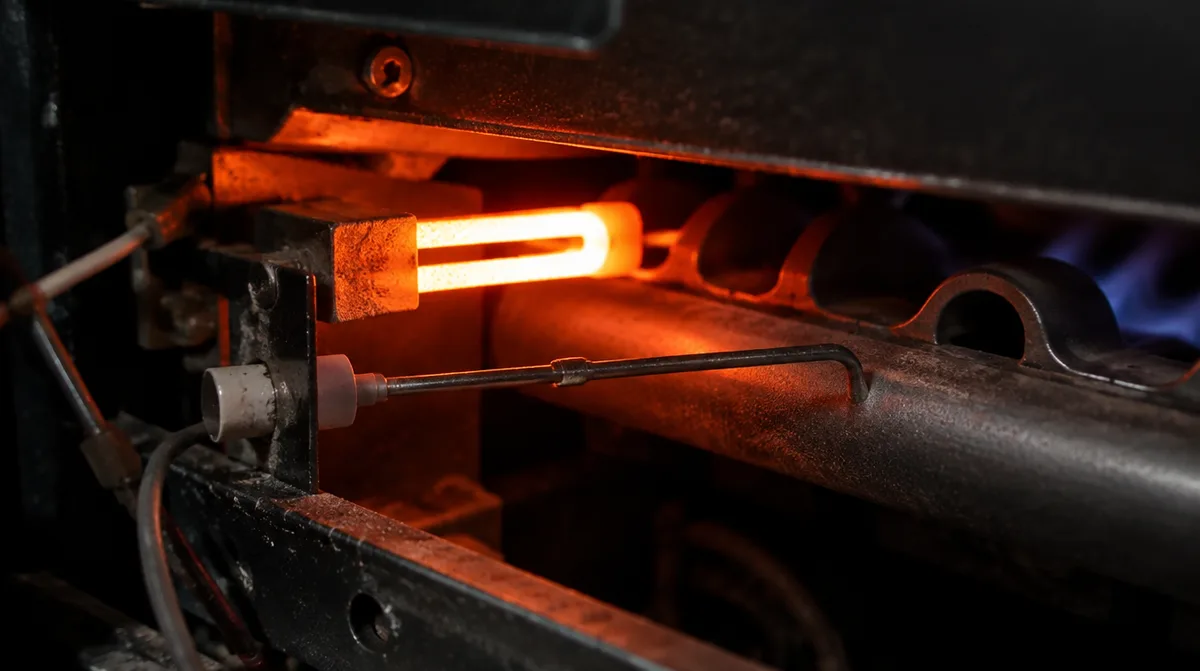
The cause is a thin oxide film on the sensor rod that prevents it from detecting the flame that is genuinely there. In Arizona, eight months of dust accumulation on a sensor nothing burns clean makes this a predictable first-cold-night failure. It is a quick, inexpensive fix. Our guide on a furnace that will not turn on walks through the full ignition sequence if you want to identify exactly where yours is stopping.
A failing igniter or a marginal pressure switch produces similar repeated-attempt behavior, and a blocked condensate drain on a high-efficiency furnace will do it too.
Cause Five: Flue and Venting Problems
Your furnace proves it can safely exhaust before it will open the gas valve. A draft inducer runs first, and a pressure switch confirms it is moving air. No confirmation, no gas.
A partially blocked flue lets the inducer satisfy the switch sometimes and not others, which produces intermittent starts and stops. After an eight-month idle period in Arizona, the blockage is sometimes literal wildlife — birds and rodents nest in flues and vents that have been quiet since February. We clear them every season.
A blocked flue is also a carbon monoxide concern, not just a cycling one. If you suspect venting problems, that moves the job out of DIY territory.
Why It Is Worth Fixing Rather Than Tolerating
Every start is the hardest moment in a furnace's operating cycle. The igniter takes a thermal shock, the inducer and blower motors draw their highest current, and the heat exchanger expands rapidly. Components rated for a certain number of cycles reach that number sooner.
There is a comfort cost too. A furnace that never runs a full cycle never distributes heat evenly, so the rooms furthest from the air handler stay cold no matter what the thermostat says.
And the efficiency cost is real. Startup is the least efficient part of any cycle, and a short-cycling furnace spends a disproportionate share of its runtime there — while in many cases also signalling that a limit switch is being tripped repeatedly, which is a safety device working overtime rather than a system operating normally.
What to Check Before Calling
Most short cycling traces back to something on this list:
- Replace the air filter and note the date.
- Open every supply register in the house and clear anything blocking a return grille.
- Check whether the thermostat is in direct sunlight at any point in the day.
- Replace thermostat batteries.
- Confirm the fan is set to AUTO rather than ON.
- Time an actual cycle — knowing it is four minutes rather than "short" helps a technician considerably.
- Pull the furnace access panel and photograph any blinking diagnostic code along with the legend printed inside.
Frequently Asked Questions
How many times per hour should a furnace cycle? Two to three in typical conditions. More than six suggests a problem, though mild Arizona weather naturally produces shorter cycles than a cold climate would.
Is short cycling dangerous? Not usually in itself, but one of its common causes is a repeatedly tripping high-limit switch — a safety device preventing an overheat. Another is a blocked flue, which is a carbon monoxide concern. Neither should be left running indefinitely.
Will a new thermostat fix it? Only if the thermostat is the cause. Replacing one to solve a dirty filter is a common and avoidable expense.
My furnace short cycles only on the coldest nights. Why? That points toward a marginal component — a flame sensor or igniter that works when conditions are easy and fails under sustained demand.
Could an oversized furnace be fixed without replacing it? Partially. Better airflow balancing and a correctly configured thermostat help. But a system substantially oversized for the load will always tend to cycle.
Get the Cycling Diagnosed
If the filter is new, the vents are open, and your furnace is still starting and stopping every few minutes, the cause is inside the cabinet or in the ductwork, and finding it takes measurement rather than guesswork.
Fast Track Heating & Cooling diagnoses short cycling across Mesa, Chandler, Gilbert, Tempe, Scottsdale, and the East Valley. See our furnace repair service, furnace repair in Tempe, or our furnace maintenance inspection. Book online or call (602) 905-4528.
Related Services
Need HVAC Help in Arizona?
Fast Track Heating & Cooling offers free estimates on all HVAC services across the Valley.
Call (602) 905-4528